
Parent Engagement
Forming Children Together
Parent Engagement
Forming Children Together
Parents entrust Mount St. Michael Catholic School with something far more valuable than an education. They entrust us with part of the formation of their children.
We receive that responsibility with gratitude, humility, and joy.
The Catholic Church recognizes parents as the primary educators of their children. The home is the first classroom. It is where children first learn to love, trust, pray, forgive, serve, persevere, and take responsibility.
MSMCS does not replace that sacred role. We strengthen it.
When parents and educators work from a shared understanding of the child, reinforce common expectations, and communicate with honesty and charity, children experience the stability they need to flourish.
That is what parent engagement means at Mount St. Michael: not simply attending events or completing volunteer hours, but joining in a genuine partnership to help every child become the person God created him or her to be.
Parents’ Role & Engagement
Parents Are the Primary Educators
No teacher knows a child precisely the way a parent does. Parents understand the child’s history, temperament, gifts, fears, habits, relationships, and hopes.
Teachers bring another essential perspective. They see how the child learns, responds to challenges, participates in a group, forms friendships, accepts correction, and grows in independence.
Neither perspective is complete by itself.
Our best work happens when families and educators share what they see, listen carefully to one another, and remain focused on the good of the child.
What Partnership Looks Like
Parent partnership at MSMCS includes:
- Supporting the Catholic identity and mission of the school.
- Reinforcing habits of prayer, virtue, responsibility, and service at home.
- Taking an active interest in the child’s learning.
- Reading school communications and responding when requested.
- Attending conferences, meetings, and important school events.
- Communicating directly with teachers when questions arise.
- Sharing relevant information about the child’s needs or circumstances.
- Supporting appropriate academic and behavioral expectations.
- Allowing children to experience age-appropriate struggle and responsibility.
- Contributing time and talent when family circumstances allow.
- Speaking about teachers, students, and other families with dignity and charity.
- Seeking resolution through the school’s established communication process.
- Helping build a community in which every family can belong.
Engagement does not require parents to be present on campus every day. Families have different schedules, responsibilities, resources, and seasons of life. Meaningful participation can take many forms.
Shared Formation Between Home and School
Children notice whether the important adults in their lives are working together.
When the messages at home and school support one another, children gain clarity. They understand that faith matters, commitments should be honored, work deserves attention, other people should be treated with dignity, and mistakes require both accountability and mercy.
That consistency does not mean that parents and educators will agree with every decision. It means disagreements are handled directly, respectfully, and with a shared commitment to truth.
We ask parents to begin with the belief that teachers care about their children. We ask teachers to begin with the understanding that parents carry the primary responsibility for their children’s formation.
Trust grows when both are willing to listen and speak honestly.
Staying Connected to Your Child’s Learning
Parents do not need to reteach every lesson or manage every assignment to remain engaged.
Healthy academic involvement includes:
- Asking children what they discovered rather than only what grade they received.
- Reading together and discussing ideas.
- Providing an orderly place and reasonable time for home study.
- Encouraging effort, attention, perseverance, and intellectual honesty.
- Helping children prepare without taking over their responsibilities.
- Reviewing teacher communication and student progress.
- Contacting the teacher when a pattern of difficulty emerges.
- Celebrating growth without making achievement the measure of the child’s worth.
As students mature, parents gradually shift from directing every task to helping children develop ownership, judgment, and responsibility.
Supporting Faith Formation at Home
The spiritual formation of a child cannot be confined to the hours spent at school.
Families strengthen faith formation when they pray together, participate in worship, practice forgiveness, serve others, discuss moral decisions, observe the liturgical year, and allow children to see faith lived sincerely.
The goal is not to create the appearance of a perfect Catholic family. There is no such family.
The goal is to build a home in which Christ is welcomed, questions can be asked, repentance is real, mercy is practiced, and every member continues to grow.
Communication That Strengthens Partnership
Questions and concerns are normal in any school community. How we address them matters.
Parents should bring classroom questions first to the teacher who is closest to the situation. Teachers should respond with care, appropriate context, and a desire to understand. If the concern cannot be resolved at that level, the school’s established process should guide the next conversation.
Productive communication is:
- Timely rather than delayed.
- Direct rather than carried through other families.
- Curious rather than accusatory.
- Specific rather than built on assumptions.
- Respectful of privacy.
- Focused on resolution and the child’s growth.
- Willing to distinguish facts from interpretations.
- Appropriate to the seriousness of the issue.
The school should communicate with the same standards of clarity, responsiveness, discretion, and charity that it asks of parents.
When a Child Encounters Difficulty
A child’s struggle is not evidence that the partnership has failed. It is often when partnership matters most.
When academic, behavioral, social, or emotional concerns arise, parents and educators should work together to:
- Establish what is actually happening.
- Listen to the perspectives of the child, family, and teacher.
- Identify factors contributing to the difficulty.
- Agree on appropriate expectations and support.
- Clarify what the student must take responsibility for.
- Establish how progress will be monitored.
- Revisit the plan honestly.
Our goal is not to remove every obstacle from a child’s path. It is to help the child face difficulty with truth, courage, appropriate support, and growing responsibility.
Volunteering & Events
Every Family Has Something to Contribute
A strong school community is built through shared efforts.
Parents bring professional knowledge, practical skills, creativity, hospitality, leadership, prayer, cultural traditions, and countless forms of service. When these gifts are offered with generosity and coordinated well, they enrich the experience of every student.
Some parents can serve regularly. Others can assist with one event, complete work from home, provide professional expertise, pray for the school, or contribute during a particular season.
The goal is not comparison. The goal is participation that is useful, sustainable, and aligned with the mission of the school.
Ways Parents Can Serve
Volunteer opportunities may include:
- Help with planning, setup or clean-up for school events
- Plan and organize staff luncheons
- Help with farm duties
- Organize the monthly parent rosary
- Clean & dust classrooms
- Assist with recess duty
- Serve students on pizza Fridays
- Help with various office tasks
- Make copies or laminate items for teachers
- Be a room mom
- Organize class parties and field trips
- Chaperone a field trip
- Gala planning and preparations
- Promote the school at local churches with Ms. Saldana
- Donate items towards classroom needs
- Donate snacks/drinks/food for staff meetings or luncheons
Volunteer Expectations
Volunteers represent the school and contribute directly to the environment experienced by students.
Parents serving on campus or at school activities are expected to:
- Support the Catholic mission and policies of MSMCS.
- Complete all required safe-environment screening and training.
- Follow school safety, arrival, check-in, and supervision procedures.
- Protect student, family, and employee confidentiality.
- Remain within the responsibilities of the assigned role.
- Follow the direction of teachers, staff members, and event leaders.
- Avoid photographing or posting students without authorization.
- Model respectful speech, conduct, and appropriate boundaries.
- Notify the coordinator promptly if they cannot fulfill a commitment.
- Raise concerns through the appropriate school channel.
Volunteering offers a meaningful view into school life, but it does not create access to confidential information or authority over instructional decisions.

Events That Bring Us Together
School events do more than fill a calendar. They give families opportunities to pray, celebrate, serve, learn, welcome others, and strengthen relationships beyond the classroom.
The annual schedule may include:
- Masses and liturgical celebrations.
- Feast-day observances.
- Sacramental celebrations and receptions.
- Parent formation or educational evenings.
- New-family gatherings.
- Open houses.
- Student performances and exhibitions.
- Athletic events.
- Service projects.
- Community meals and family celebrations.
- Outdoor workdays.
- Fundraising events.
- The Virtus et Veritas Gala.
- Alumni and anniversary gatherings.
- End-of-year and graduation traditions.
Not every family will attend every event. We encourage parents to choose meaningful ways to enter the life of the community throughout the year.
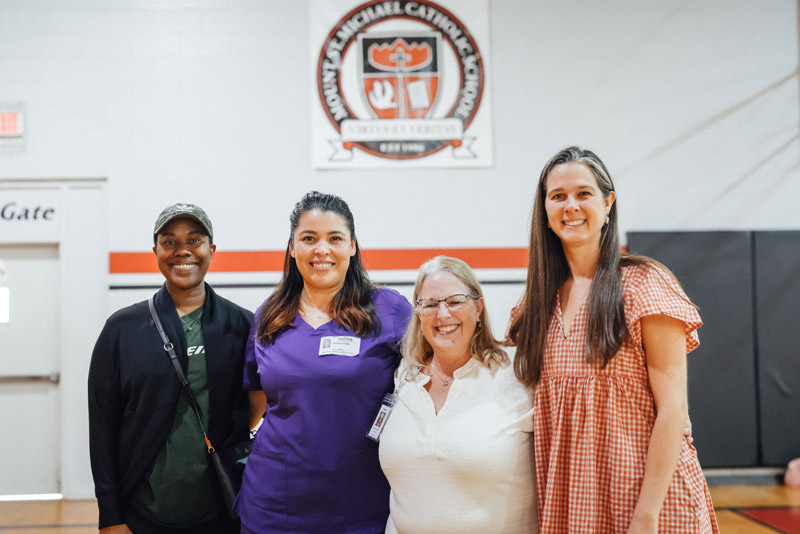
Share Your MSMCS Story
Every family experiences the school differently. Your story may help another parent understand something no program description can communicate.
We welcome stories about:
- How your family found MSMCS.
- A teacher who made a lasting difference.
- Your child’s academic or personal growth.
- Faith entering more deeply into family life.
- A friendship or tradition that created belonging.
- A volunteer experience that changed your relationship with the school.
- Support received during a difficult season.
- How an MSMCS graduate was prepared for high school and beyond.
Community Story Form
A Place for the Whole Family
Mount St. Michael is not only a place where children attend school. It is a community in which families seek to grow in knowledge, virtue, faith, and holiness together.
Parents help make that community possible—not because the school expects every family to contribute in exactly the same way, but because strong communities are created when people bring their gifts, honor their responsibilities, and care for something larger than themselves.
Whether you serve regularly, help with one event, pray faithfully, welcome a new family, share professional expertise, or quietly support a teacher, your contribution matters.
Together, we create the environment in which children can become the people God created them to be.