The Curriculum
A Curriculum Designed Around How Children Grow
The Curriculum
A Curriculum Designed Around How Children Grow
What children are ready to learn, and how they are ready to learn it, changes as they mature.
A toddler needs movement, language, trust, and opportunities to do meaningful things independently. A preschool child is ready to concentrate, classify, practice, and build foundational skills. An elementary student eagerly absorbs stories, facts, patterns, rules, and vocabulary. An older student begins questioning, connecting, evaluating, and articulating ideas.
The MSMCS curriculum follows that natural progression.
Montessori education provides the foundation through kindergarten. Classical education builds upon it from first through eighth grade. Faith, virtue, truth, goodness, beauty, and the partnership between school and family remain central throughout.
A CONNECTED CURRICULUM
Four Stages. One Purpose.
Each MSMCS program has its own methods, materials, expectations, and academic priorities. Yet the stages belong to one coherent educational path.
| Program | Age or Grade | Primary Developmental Work | Preparation for the Next Stage |
|---|---|---|---|
| Toddler Montessori | 18 months–3 years | Trust, language, movement, coordination, order, and independence | Readiness to participate more independently in a prepared learning community |
| Children’s House | Pre -K3–Kindergarten | Concentration, purposeful choice, foundational literacy and mathematics, practical life, and self-discipline | Strong habits and foundational skills for first grade |
| Classical Grammar School | Grades 1–4 | Language, memory, academic fluency, broad knowledge, stories, facts, patterns, and categories | Knowledge and habits needed for analysis and independent reasoning |
| Classical Dialectic/Logic School | Grades 5–8 | Connection, analysis, logical reasoning, moral discernment, discussion, and expression | Academic and personal readiness for high school |
Across every stage, the curriculum asks not only, “What does this student need to know?” but also: Who is this child becoming?
18 Months–3 Years
Toddler Montessori
The Beginning of Independence
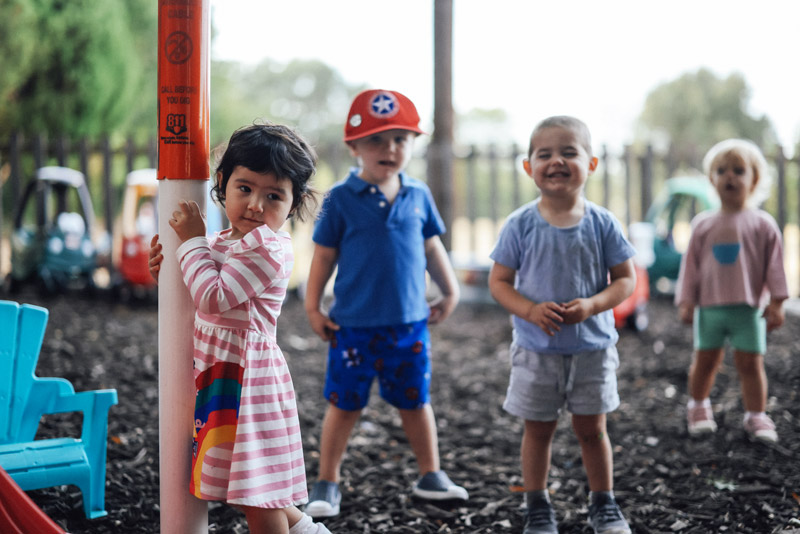
Toddlers possess an intense desire to move, communicate, imitate, explore, and participate in the world around them.
The Toddler Montessori environment is designed to respect those natural drives while providing the calm, order, boundaries, and personal attention young children need to feel secure.
Guides observe each child carefully, model for purposeful activity, offer developmentally appropriate lessons, and allow time for repetition. Children are encouraged to attempt meaningful tasks for themselves while receiving help when they truly need it.
The goal is not to accelerate children into preschool academics. It is to establish the physical, emotional, linguistic, social, and practical foundations upon which later learning depends.
The Prepared Environment
Everything within the classroom is chosen and arranged with the young child in mind.
Low shelves make materials accessible. Child-sized furniture and tools allow children to participate more independently. Activities follow a clear sequence and have a defined purpose. Children learn to choose work, use it carefully, complete it, and return it for another person.
The environment communicates an important message:
You belong here, and you are capable of meaningful work.
Toddler Curriculum Areas
Practical Life and Self-Care
Children participate in age-appropriate activities involving:
- Washing
- Dressing
- Toileting
- Eating
- Pouring
- Carrying
- Cleaning
- Organizing
- Caring for their belongings
- Caring for the classroom
These activities develop independence, concentration, coordination, sequencing, confidence, and respect for the shared environment.
Language
Toddlers are immersed in precise, respectful language.
Guides name objects, describe actions, engage children in conversation, read aloud, sing, listen to music, and help children communicate needs and intentions. Language grows through real relationships and meaningful experiences rather than passive exposure alone.
Gross-Motor Development
Children need room to walk, run, climb, balance, jump, carry, and move through space.
Indoor and outdoor movement helps develop strength, balance, coordination, body awareness, confidence, and judgment.
Fine-Motor Development
Reaching, grasping, transferring, sorting, placing, opening, closing, using utensils, working with art materials, and manipulating appropriately sized objects prepare the hand for increasingly precise work.
Sensory Exploration and Problem-Solving
Materials invite children to notice differences in size, shape, texture, weight, sound, color, and spatial relationships.
Through exploration and repetition, toddlers begin developing attention, comparison, persistence, and practical problem-solving.
Grace, Courtesy, and Community
Toddlers begin learning how to wait, take turns, care for materials, interact with peers, participate in group activities, and respond to adult guidance.
These early social experiences establish a foundation for life in a learning community.
Faith
Prayer, sacred music, religious language, reverent example, and participation in the Catholic rhythm of the school introduces children to a relationship with God.
At this age, faith is communicated most powerfully through trust, peace, beauty, order, love, and the example of adults.
What Growth May Look Like
Every toddler develops at an individual pace. Over time, parents may see growth in the child’s ability to:
- Separate from a caregiver with increasing confidence
- Communicate needs more clearly
- Choose and complete purposeful activity
- Concentrate for longer periods
- Care for personal belongings
- Participate in self-care
- Move with greater coordination
- Restore materials and help care for the environment
- Interact more peacefully with other children
- Accept familiar routines and transitions
- Experience growing confidence: “I can do it.”
Pre-K3–Kindergarten
Children's House
Foundations Take Root
Children’s House brings preschool and kindergarten students together within a carefully prepared Montessori community.
The mixed-age environment creates continuity and allows children to learn in multiple ways. Younger children observe advanced work and absorb the culture of the classroom. Older children gain confidence, reinforce their understanding, model responsibility, and develop leadership skills.
Guides follow the child’s developmental readiness while maintaining clear expectations and an ordered environment. Children experience purposeful choice, not unlimited freedom, and learn that independence carries responsibility.
The Montessori Work Cycle
A sustained work period gives children time to select an activity, concentrate, repeat it, complete it, and restore it without unnecessary interruption.
Guides provide individual and small-group lessons, observe progress, and introduce new materials when the child is ready. The goal is not to keep every child doing the same work at the same moment. It is to help each child progress through a carefully sequenced curriculum while developing concentration and self-discipline.
Children’s House Curriculum Areas
Practical Life
Practical-life exercises help children coordinate movement, follow sequences, care for themselves, care for the environment, and participate responsibly in the classroom community.
Activities may involve pouring, transferring, fastening, food preparation, cleaning, arranging, polishing, washing, gardening, and other meaningful tasks.
These exercises prepare the mind and hand for more advanced academic work while building independence and confidence.
Sensorial Development
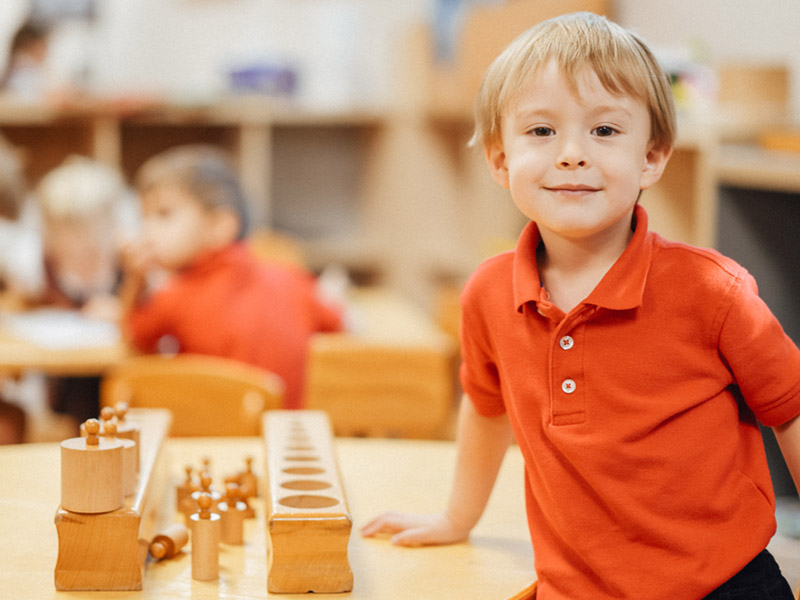
Montessori sensorial materials isolate qualities such as size, shape, length, weight, color, sound, texture, and dimension.
Children learn to compare, classify, grade, sequence, and describe what they perceive. These abilities support later work in mathematics, language, science, art, and observation.
Language and Literacy
Children develop spoken language, vocabulary, phonemic awareness, letter-sound knowledge, reading, handwriting, grammar, and written expression at their own pace and according to their readiness.
Language development begins with engaging, hands-on activities, including sound games, sound baskets, and familiar objects that help children recognize phonetic sounds and identify initial letter sounds. Sandpaper letters and movable alphabets allow children to explore letter formation and word construction before their fine motor skills are ready for writing with a pencil.
Teachers further enrich language development through nursery rhymes, fables, songs, and storytelling, expanding vocabulary, nurturing imagination, and introducing children to the world around them.
Rather than following a rigid timetable, each child is encouraged to build a strong foundation in literacy and progress naturally toward confident reading, writing, and communication.
Mathematics
Children move from concrete experience toward abstract mathematical understanding.
Montessori materials, like number rods, sandpaper numerals, spindle boxes and counters, help them encounter quantity, number symbols, place value, sequence, decimal system, and mathematical operations. Children learn not merely to produce an answer, but to understand what quantities and operations mean.
Geography, Science, and Culture
Children explore the physical and human world through maps, land and water forms, continents, cultures, plants, animals, classification, observation, experiments, stories, art, and music.
These studies expand vocabulary and awaken interest in the world beyond the child’s immediate environment.
Catechesis of the Good Shepherd
Within the atrium, children encounter scripture, explore mass and liturgy, study the Land of Israel and the city of Nazareth, and spend time in prayer.
Catechesis of the Good Shepherd respects the young child’s capacity for a genuine relationship with God and creates space for contemplation, wonder, and response.
Art, Music, and Movement
Artistic activity, music, song, rhythm, dance, outdoor play, and purposeful movement support creativity, coordination, expression, beauty, joy, and physical development.
Grace, Courtesy, and Responsibility
Children practice greeting others, waiting, listening, speaking respectfully, caring for shared spaces, resolving conflict, helping classmates, and accepting responsibility for their choices.
These are not secondary social skills. They are part of learning how to live well within a community.
Preparation for First Grade
By the completion of Children’s House, students should have made meaningful progress toward:
- Independence in personal and classroom responsibilities
- Sustained concentration
- Respect for materials and other people
- Pattern reading
- Legible D’Nealian writing skills
- Number sense and early mathematical operations
- Clearer spoken language
- Careful observation and classification
- Confidence selecting and completing work
- Participation in prayer and community life
- Curiosity and readiness for more structured classical study
These are developmental aims, not universal guarantees. Each child’s progress should be understood through actual readiness, growth, and demonstrated ability.
Grades 1–4
Classical Grammar School
Building a Storehouse of Knowledge
The grammar stage corresponds with a period when children readily absorb language, stories, songs, facts, patterns, rules, and categories.
Students enjoy repetition, recitation, discovery, and memorable stories. They are developing academic tools that will allow them to read, write, calculate, investigate, and communicate with increasing fluency.
MSMCS uses these natural strengths to establish a broad foundation of knowledge across subjects.
Memorization is part of the grammar stage, but it is not the whole of it. Students also narrate, observe, experiment, discuss, write, create, solve problems, explore nature, and connect with what they are learning.
The goal is knowledge joined with understanding and delight.
Grammar School Curriculum Areas
Faith Formation: Catechesis of the Good Shepherd & Religion Classes
Catechesis of the Good Shepherd: Children work with materials representing Jesus as the True Vine and themselves as the branches. Spending time learning about the liturgical calendar, students learn about vestment colors and the order of the Mass. Children reflect on the parables to learn right from wrong and learn more about the Old Testament. Together children continue to discover their role in God’s plan and their own place in the community of believers.
In the classroom, students deepen their knowledge of Scripture, Catholic teaching, the Sacraments, prayer, the liturgical year, and the lives of the saints.
Daily Mass, the Angelus, Adoration, Confession, service, and Catechesis of the Good Shepherd connect religious knowledge with the lived faith of the school. Students begin asking what their place is within God’s work and how faith should shape their choices and treatment of others.
Reading and Literature
Students begin to transition from basic sound identification to advanced phoneme manipulation and written letters. Instruction in the classroom focuses on complex syllable structures, fluency, comprehension, vocabulary, and continue to engage with increasingly substantial texts.
Worthwhile stories expose children to virtues such as courage, failure, sacrifice, friendship, justice, mercy, loyalty, and the enduring questions of human life. Literature expands imagination while giving students material for narration, discussion, and reflection.
Grammar, Writing, and Spelling
Students learn the structure and conventions of language while developing handwriting, spelling, sentence formation, paragraph development, narration, composition, and revision.
Beginning in 3rd grade, students complete a thorough study of grammar using Well-Ordered Language which helps them to understand how language works. Students are presented with rules of grammar by memorizing songs, analyzing sentences, practicing, and reviewing the art of the English language. Understanding how grammar is embodied in the sentences, students learn to analyze and diagram sentences.
Also beginning in 3rd grade students use Institute of Excellence in Writing (I.E.W) producing various genres of writing pieces. Beginning with the basics-rewriting a paragraph students learn to outline, select keywords, summarize, and add stylistic techniques (e.g. strong verbs, quality adjectives, and a variety of sentence openers). Institute of Excellence helps to take the focus off what to write and instead emphasizes how to write. Writing is treated as an act of thinking. Students learn to organize what they know.
Mathematics
RightStart Mathematics reminds us that “Math is one of the greatest tools humans have inherited.” Students are asked to pay close attention to vocabulary used while being exposed to a large number of topics. These challenging topics are built sequentially for better understanding. In grades 1st-5th, the philosophy of our math program focuses on:
- Visualization skills, not counting or rote memory
- Games, not flash card drills
- Place value to the thousands, not memorizing counting words to 100
- Linear fractions, not fraction circles
- Real problem solving, not looking for “keywords”
- Geometrical constructions, not learning definition
Students are encouraged to play math games each night as a way to reinforce skills learned in the classroom. Instruction should develop accuracy and understanding. Students learn procedures, while also learning why those procedures work and how mathematics reveals order and relationships.
History & Geography
History is taught through people, places, events, cultures, stories, chronology, cause, and consequences. Students build a chronological framework that helps them understand when events occurred, how civilizations developed, and how ideas and human choices have shaped the world.
Maps, regions, landforms, cultures, nations, and the relationship between people and places help students locate historical and contemporary knowledge within the physical world.
Science and Nature Study
For 1st through 5th grades, Nancy Larson’s Science builds a strong science foundation within our students by producing students who develop critical thinking skills, ask appropriate questions, and make connections to the world around them. Throughout their time in grades 1-5, students will encounter topics in all three branches of science – life, physical, and earth sciences. They receive an interactive student booklet which serves as a science lab book filled with research, science illustrations, and room for their own observations.
Not only do students engage in science classes in the classroom, they attend an Agricultural Studies class once a week at our school farm. During this time, students learn about the animals on our farm and how to build soil through composting. It is an incredible opportunity to have our students learn about God’s creation through their weekly hands-on curriculum.
Life science, physical science, earth science, outdoor learning, agricultural studies, the farm, gardens, and apiary give students opportunities to connect scientific knowledge with direct experience.
Latin
Latin develops vocabulary, memory, grammatical awareness, precision, and an understanding of linguistic roots.
It also introduces students to a language deeply connected with the Catholic Church and with terminology used in literature, history, law, medicine, and science.
Art
At Mount St. Michael, students continue their study of truth, beauty, and goodness through art. Students engage with artists from Meet the Master Art Program by copying their works. They are taught various techniques that support the importance of learning about the history and culture of our world. Students will participate in various projects from drawing to painting throughout the school year.
In the Spring, students will display their art during a school wide event called “Celebration of the Arts”. This is a culminating exhibit of student artwork for parents and visitors to view.
Music
Music is a core pillar of the curriculum at Mount St. Michael Catholic School. It is treated as essential because it shapes the mind, soul, and enriches the community. It instills what is good, true, and beautiful. Students in grades 1-4 attend music once a week.
Beginning in 4th grade, students may volunteer to sing in the choir during daily mass. Guitar lessons are offered and encouraged for those wanting to prepare to participate in Music Ministry in the upper grades.
Physical Education and Outdoor Learning
Students have a 20-minute recess each day. At MSMCS movement, play, physical education, athletics, time outdoors, and practical work help students develop strength, coordination, teamwork, confidence, responsibility, and healthy habits. Students also attend P.E. twice a week for 40 minutes.
How Grammar Students Learn
Grammar-stage instruction may include:
- Direct instruction
- Read-alouds
- Narration
- Recitation
- Song and rhythm
- Memorization
- Copy work and dictation
- Guided practice
- Hands-on investigation
- Demonstration
- Discussion
- Outdoor observation
- Art and performance
- Individual and collaborative work
The methods vary according to the subject, but the purpose remains consistent: help essential knowledge become meaningful, connected, and durable.
Preparation for the Dialectic/Logic Stage
By the end of fourth grade, students should be increasingly able to:
- Read texts with understanding
- Write organized and increasingly developed paragraphs and compositions
- Apply mathematical knowledge accurately
- Recall and organize important information
- Locate events and ideas within historical and geographic context
- Observe and describe the natural world carefully
- Recognize patterns and relationships
- Ask useful questions
- Participate respectfully in discussion
- Accept responsibility for preparation and work
- Connect faith with conduct
- Approach learning with curiosity and perseverance
Grades 5-8
Classical Dialectic/Logic School
Learning to Reason Clearly
As students approach adolescence, they naturally begin asking more complex questions.
Why is this true? How do we know? What caused this? What follows it? Are these ideas consistent? What is the evidence? What should a person do?
The dialectic or logic stage teaches students how to pursue those questions responsibly.
Students learn to connect with the knowledge they have acquired, distinguish sound reasoning from weak reasoning, evaluate information, recognize assumptions, support conclusions, listen carefully, and express ideas with increasing precision.
The goal is not argument for argument’s sake. It is the disciplined pursuit of truth.
Dialectic/Logic School Curriculum Areas
Religion, Theology, and Moral Formation
There are several opportunities for older students to engage with the Church. In the classroom students continue to examine Scripture, Catholic teaching, the sacraments, salvation history, human dignity, virtue, vocation, relationships, responsibility, and service with increasing depth.
5th grade is the conclusion of Catechesis of the Good Shepherd at Mount St. Michael Catholic School. In Level 3, students learn about sacred history, typology, moral life and virtues, and participate in a deeper exploration of the Mass, the Sacraments, and Church history.
They are challenged to move beyond repeating what they have been taught. They must learn to understand why the Church teaches what it does, and how truth should guide concrete choices.
Prayer, daily Mass, Adoration, Confession, virtues, and the example of the school community keep theological study connected to lived faith.
Literature
Students encounter increasingly complex literature and examine character, theme, structure, language, conflict, moral choice, historical context, and the author’s ideas.
At MSMCS, we want students to be able to read deeply, reflect insightfully, and respond articulately. Carefully selected texts that embody truth, beauty, and goodness are chosen to develop habits of reading great literature. All grades read several whole novels, in addition to an assortment of short stories, poems, and informational texts.
We want our students to develop a working familiarity with any of the great novels throughout time. Students engage with the text and their peers by participating in Socratic discussions. Teachers pose questions that guide students to create evidence-based responses and analyze the text critically. Discussion teaches students to support interpretations with evidence, listen to other perspectives, revise weak conclusions, and recognize that serious texts often resist superficial answers.
Composition and Language
Beginning in 3rd grade, students complete a thorough study of grammar using Well-Ordered Language which helps them to understand how language works. Students are presented with rules of grammar by memorizing songs, analyzing sentences, practicing, and reviewing the art of the English language. Understanding how grammar is embodied in the sentences, students learn to analyze and diagram sentences.
3rd-6th grade students use Institute of Excellence in Writing (I.E.W) producing various genres of writing pieces. Beginning with the basics-rewriting a paragraph students learn to outline, select keywords, summarize, and add stylistic techniques (e.g. strong verbs, quality adjectives, and a variety of sentence openers). Institute of Excellence helps to take the focus off of what to write and instead focuses on how to write.
7th– 8th grade students continue to refine their writing with Lost Tools of Writing (LTOW) a classical writing program. This program covers areas of invention, arrangement, and elocution. Students are guided through the process of developing a thesis statement for a persuasive essay by completing 8 different essays. Learning to select a thesis, create an outline, provide evidence using MLA format, and eventually address the counterargument to complete a well written persuasive essay. This program helps students to identify what his/her point is. Students also complete a research paper during Academic Museum and other genres of writing integrated in all subject areas.
They learn to formulate a clear idea, organize an argument, support claims with evidence, explain relationships, anticipate questions, revise for logic and clarity, and speak with confidence. Grammar, vocabulary, usage, and mechanics remain important because clear expression depends upon command of language.
Logic and Reasoned Discussion
Students learn the habits of sound reasoning.
They begin recognizing definitions, propositions, relationships, assumptions, contradictions, valid conclusions, weak arguments, and common errors in thought.
Classroom discussion becomes an opportunity to ask better questions, explain reasoning, disagree respectfully, and pursue truth collaboratively.
Mathematics
6th Grade Geometry: Unlike other curricula, 6th grade students continue their study of Algebra through a geometric approach using RightStart Mathematics. Using tools often found in engineering drafting courses, teachers “coach” students on how to read a math textbook. Using a gradual release model students gain more independence while exploring the world of Geometry. The program used by MSMCS encourages students to understand that Geometry is more than quantity. It is about measurement and the relationship between those measurements.
7th Grade Geometry: Students continue to use tools often found in engineering drafting courses, while using the teacher as a facilitator as they continue Level H, which is the last level of RightStart Mathematics. Students continue to independently develop and build on pre-algebra objectives by completing concrete practices with higher level math. not just with geometry but also arithmetic and algebra. After completing the curriculum, students are prepared for Algebra.
8th Grade Algebra: “All Things Algebra” is both a ready‑made teaching resource and full coverage of the algebra curriculum, from basic arithmetic with variables to advanced functions, ensuring a logical progression and comprehensive skill development.
Science
Students study the natural world through increasingly disciplined observation, experimentation, measurement, evidence, analysis, and explanation.
Students use Novare Science which is a mastery-based science curriculum for Christian upper schools. The curriculum “rejects today’s artificial conflict between faith and science. It affirms Jesus Christ as the center of all things.” Each year students study the three branches of science – life, physical, and earth.
During 7th grade, all students will incorporate the scientific method through designing an experiment, collecting data, analyzing results, and drawing conclusions. Students will present their findings during our annual Academic Museum.
Scientific study helps students distinguish observation from inference, recognize relationships, evaluate conclusions, and understand the order and complexity of creation.
History, Civics, and Geography
Students examine historical events and cultures through cause and consequence, geography, institutions, ideas, conflict, leadership, moral choice, and the experiences of people across time.
The goal is not simply chronological recall. Students learn to compare, interpret, evaluate sources, recognize complexity, and consider what history reveals about human nature and responsibility.
Latin
Continued Latin study strengthens vocabulary, grammatical precision, memory, analytical habits, and access to the linguistic inheritance of the Church and Western civilization.
The Arts
Art, music, dance, performance, and the study of beauty help students develop perception, creative discipline, confidence, cultural understanding, and the ability to express meaning.
Physical Education and Athletics
Physical education and athletics help students develop strength, skill, self-control, teamwork, perseverance, humility, and the ability to respond well to competition.
Outdoor Learning and Agricultural Studies
The farm, gardens, apiary, outdoor classrooms, and natural areas allow students to investigate ecosystems, stewardship, food systems, measurement, animal care, and practical problems.
Service and Leadership
Older students should accept greater responsibility within the school and wider community.
Service, mentoring, club participation, classroom responsibilities, athletics, and school traditions create opportunities to lead through examples rather than status.
How Dialectic/Logic Students Learn
Instruction may include:
- Direct teaching
- Seminar-style discussion
- Formal and informal debate
- Analytical writing
- Research
- Presentations
- Scientific investigation
- Mathematical problem-solving
- Comparative analysis
- Primary and secondary sources
- Individual and collaborative projects
- Recitation and memory
- Service and reflection
- Outdoor and practical learning
Students receive guidance and structure while being expected to assume increasing responsibility for preparation, conduct, time, materials, and the quality of their work.
Preparation for High School
By the completion of eighth grade, students should be increasingly able to:
- Read substantial texts with comprehension
- Write organized, clear, and evidence-based compositions
- Speak confidently and listen carefully
- Think logically
- Identify assumptions and evaluate arguments
- Apply mathematical reasoning
- Conduct disciplined scientific inquiry
- Connect knowledge across subjects
- Understand events within historical and cultural context
- Ask meaningful questions
- Evaluate new information rather than merely accept it
- Defend a conclusion while remaining open to correction
- Manage increasingly independent academic work
- Treat others with dignity
- Make principled decisions
- Serve generously
- Enter high school with academic confidence and personal maturity
These outcomes should eventually be supported by current assessment results, graduate data, high-school placement information, alumni experiences, and feedback from receiving schools.
ACADEMIC EXCELLENCE WITH PURPOSE
What the Curriculum Is Ultimately For
The purpose of the MSMCS curriculum is not to produce students who can merely recall information, pass examinations, or accumulate credentials.
Knowledge matters because truth matters.
Clear reasoning matters because students will encounter complicated ideas and consequential decisions.
Writing and speaking matter because truth must be communicated.
Character matters because ability can be used well or poorly.
Faith matters because it gives knowledge, achievement, freedom, and service their deepest purpose.
The curriculum exists to help form young people who know Jesus Christ, love truth, choose what is good, recognize beauty, reason clearly, communicate confidently, and use their gifts in service to others.
Plan Your Visit
Find the Right Place for Your Child to Begin
Every stage of the curriculum prepares students for what comes next while respecting the developmental work of the present.
Explore the program that corresponds with your child’s age or visit Mount St. Michael to see the curriculum in action.